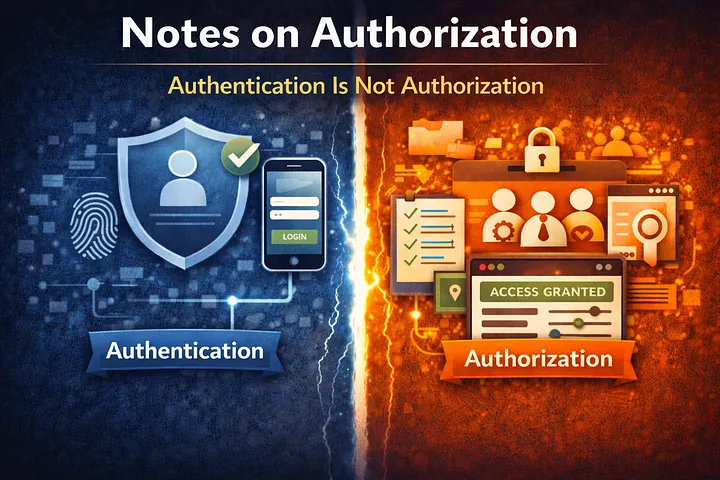
Authentication often feels like the starting point of authorization. It’s foundational, so it’s easy to assume the two are tightly coupled, or even interchangeable.
They aren’t.
Authentication and authorization solve related problems, but they answer fundamentally different questions. Conflating them blurs system boundaries and pushes decision-making into places where it becomes difficult to reason about later.
What authentication actually answers
Authentication answers a single question:
Who is making this request?
It establishes identity. Nothing more.
Whether that identity comes from a password, a token, a certificate, or a federated provider doesn’t change the outcome. Authentication produces a subject the system can recognize.
What it does not determine is what that subject is allowed to do.
Why identity isn’t permission
Once a request is authenticated, all meaningful decisions still remain.
Knowing who someone is does not imply:
- what actions they’re allowed to perform
- which resources they can access
- under what conditions those actions are valid
- how context affects the outcome
Those questions are authorization concerns.
Problems arise when authenticated identity is treated as implicit permission, when the mere presence of a valid credential stands in for a decision that was never explicitly evaluated.
Where systems start to blur the boundary
A common failure mode is letting authorization logic leak into authentication artifacts.
Permissions get embedded in tokens. Role names become claims. Scopes start carrying business meaning. Over time, identity outputs quietly turn into policy.
At first, this feels convenient. Decisions appear to be “already made.” But the coupling is subtle and costly.
When authorization lives inside identity artifacts:
- changes require reissuing credentials
- behavior becomes fixed earlier than necessary
- context is difficult to incorporate
- policies become harder to evolve
What should be a flexible decision process becomes a static assertion.
Authentication as prerequisite, not authority
A cleaner model is to treat authentication as a prerequisite, not a source of permission.
Authentication establishes identity and attributes. Authorization evaluates whether an action is allowed using those attributes, along with capabilities and context.
In this framing:
- authentication answers who
- authorization answers whether They interact, but they don’t replace each other.
Keeping this boundary clear prevents identity systems from becoming accidental policy engines.
Why this separation matters over time
Systems evolve. Requirements change. Context expands.
When authentication and authorization are tightly coupled, change becomes risky. Adjusting permissions means touching identity infrastructure. Introducing new rules requires redefining tokens or claims. Over time, this friction discourages improvement.
When the boundary is respected, systems remain adaptable. Identity stays stable. Authorization logic evolves independently. Decisions become more expressive without destabilizing the foundation beneath them.
Authentication is essential, but it isn’t authorization.
Treating identity as authority may work early on, but it doesn’t scale conceptually or operationally. Systems that last tend to respect the boundary: authentication to establish who is present and authorization to decide what is allowed.
Keeping those concerns distinct makes systems clearer, safer, and far easier to evolve.