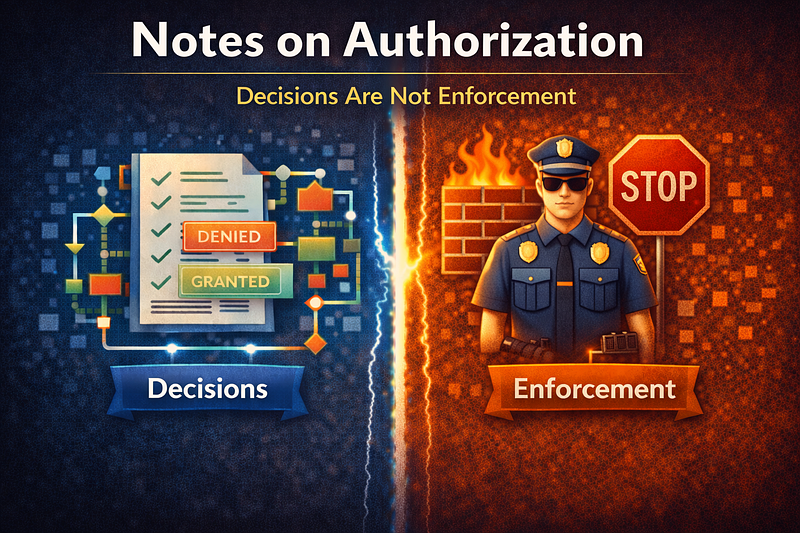
Once authorization logic becomes explicit, another distinction starts to matter: the difference between deciding whether an action is allowed and enforcing that decision.
These two concerns are closely related, but they are not the same thing. Systems that treat them as interchangeable tend to accumulate hidden complexity in places that are hard to test and harder to evolve.
What authorization decisions actually are
An authorization decision answers a single question:
Given this actor, this action, this resource, and this context - should it be allowed?
That decision is evaluative. It produces an outcome: allow or deny (sometimes with additional information).
Importantly, a decision is not an action. It doesn't stop a request, throw an error, or return a response. It simply determines whether something should happen.
That separation is subtle, but foundational.
What enforcement actually does
Enforcement is the act of applying a decision.
It's where requests are blocked, errors are returned, workflows are halted, or UI elements are disabled. Enforcement happens at the edges of the system - in APIs, services, user interfaces, and integrations.
Unlike decisions, enforcement is necessarily tied to execution. It depends on where the request is handled and how the system responds.
Conflating the two tends to blur responsibilities.
Where systems collapse the distinction
A common pattern is to embed authorization checks directly inside business logic:
if not allowed:
    return error
At small scale, this feels natural. The decision and its enforcement happen in the same place, often in the same line of code.
As systems grow, this coupling becomes costly. Authorization logic spreads across services. Decisions become implicit. Behavior is enforced, but the reasoning behind it is hard to locate, test, or change.
The system still works, but understanding why something was denied becomes difficult.
Why separating decisions matters
When authorization decisions are treated as a distinct concern, several things improve quietly:
- Decisions become testable without executing behavior
- Reasoning becomes centralized instead of scattered
- Enforcement becomes consistent across boundaries
- Changes affect fewer parts of the system
The system gains the ability to explain itself. You can ask not just whether something was denied, but why.
That's nearly impossible when decisions are buried inside enforcement paths.
Enforcement belongs at the boundary
Enforcement is still necessary - but it belongs at the boundary where actions occur.
APIs enforce decisions by rejecting requests. UIs enforce decisions by hiding or disabling actions. Workflows enforce decisions by halting progress.
What they should not do is decide.
By the time enforcement happens, the decision should already be known. Enforcement simply applies it in a context-appropriate way.
Decisions as a shared capability
Once decisions are separated, they can be reused.
The same authorization decision can be evaluated:
- before an API call
- during a workflow
- when rendering a UI
- during background processing
Each context enforces the outcome differently, but the decision itself remains consistent.
This reduces duplication and prevents subtle mismatches where different parts of the system enforce slightly different rules.
Authorization decisions and enforcement serve different purposes.
Decisions determine whether an action should be allowed. Enforcement determines how that outcome is applied. Treating them as the same thing works briefly, but doesn't scale.
Systems that last tend to separate the two - making decisions explicit, testable, and reusable, and leaving enforcement to the boundaries where it belongs.